
Prototype planning
Vacuum Casting or CNC Machining? Choosing a Prototype Process
by MechVibe Team · 3 min read
Compare material fidelity, design changes, tooling and functional requirements before selecting a low-volume manufacturing route.
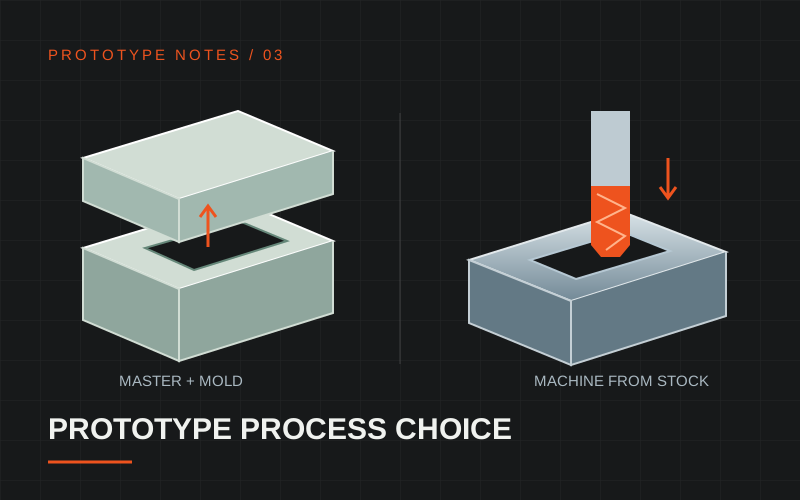
The first question in prototype planning is what the sample must prove. An appearance model, an assembly check and a loaded functional test can require different materials and production routes, even when their CAD geometry is identical.
Understand what each route produces
In plastic prototyping, vacuum casting commonly uses a master pattern and a silicone mold to reproduce parts in a casting resin, often polyurethane. The resin is selected for the properties needed by the sample. Xometry's urethane casting design guide explains the master-and-mold approach.
CNC machining removes material from metal or engineering-plastic stock. This makes it possible to specify a stock material grade for a prototype, provided that the geometry can be reached by the tools. Protolabs' plastic prototyping discussion describes how material and geometry affect that choice.
Match the sample to the test
For a visual demonstration, color, texture and the representation of the outer shape may be the priority. A cast resin can be considered if its properties meet that purpose.
For a bearing fit, loaded bracket or test involving temperature and chemicals, the actual material grade may matter more. A resin described as “ABS-like” should be assessed against the required properties; the description does not make it identical to production ABS. When using a prototype for functional decisions, record both the process and the material used.
Compare the cost of changes
Casting requires preparation of a master and mold. A geometry revision may require updates to that tooling. CNC machining requires programming and workholding preparation, and revisions may change those as well.
There is no universal quantity at which one route becomes cheaper. Compare the quoted setup cost, part cost, finishing and inspection for the actual design. If revisions are likely, ask how a change would affect price and delivery before approving the sample order.
Keep critical features visible in the comparison
Identify the interfaces that determine whether the sample passes its test: locating holes, sealing faces, threaded features or sliding fits. Ask how those features will be produced and measured on each proposed route.
Also define which results the prototype cannot demonstrate. A successful appearance review alone does not establish the strength or thermal behavior of a later production material.
Prepare a decision-focused RFQ
Send the model and drawing with:
- The purpose of the prototype and intended test.
- Required material properties or a fixed material grade.
- Quantity now and expected quantity after approval.
- Critical dimensions, surface finish and appearance needs.
- Expected design changes and requested delivery.
For a machined prototype, the MechVibe factory team can review tool access, material, tolerances and inspection with your quotation. Confirm the proposed process against the test requirements before releasing the order.